The independent appliance repair shop across the Southeast
Dryer Vent Cleaning & Repair — Book a Visit Today
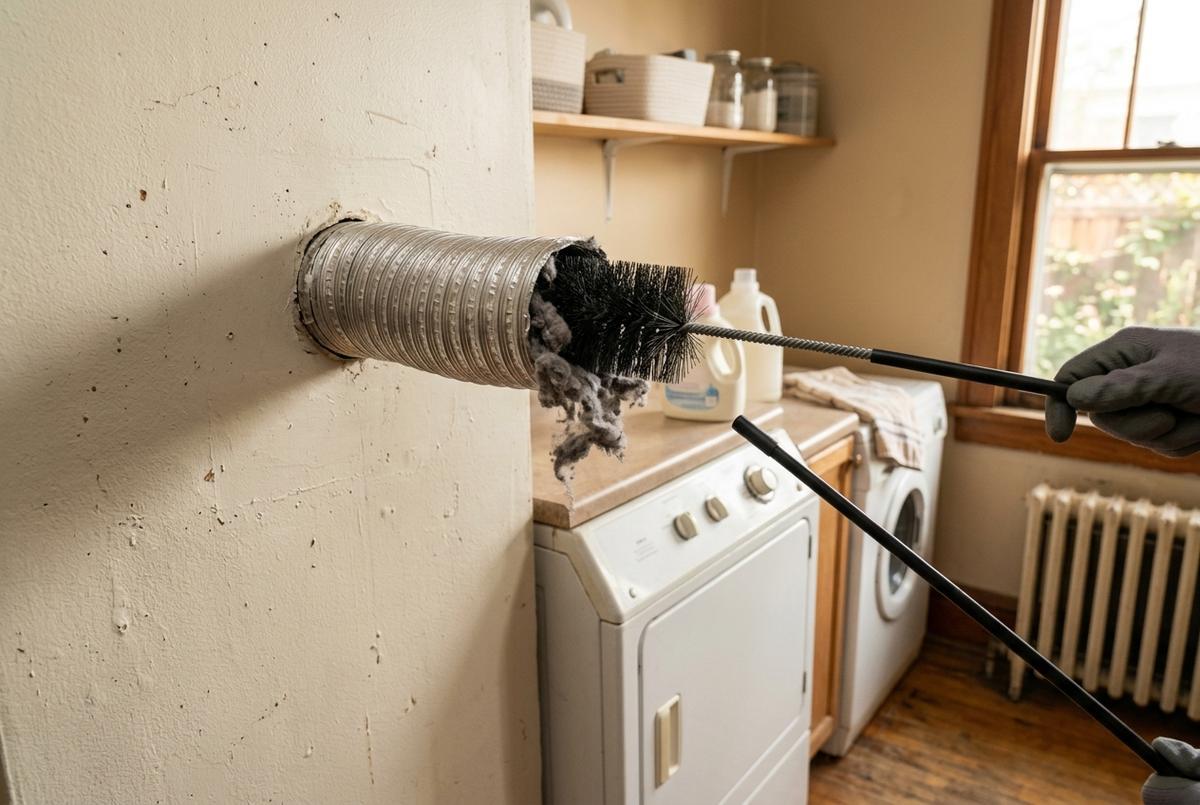
We clean and repair dryer vents, and the fix usually starts with checking real airflow at the exterior hood after we pull the dryer out. Lint doesn't stay in the trap. It rides the airflow, sticks to the duct wall, and slowly chokes the path out of your house. Once that duct is packed, the dryer can't dump heat or moisture, so clothes come out damp, cycles run twice, and the cabinet gets hot to the touch. A crushed transition hose behind the machine does the same damage as a bird nest in the roof cap or a flap that no longer opens. We brush and vacuum the full run, replace collapsed or foil hose, and repair or swap a bad termination cap. Call us and tell us what your laundry feels like coming out.
Call (888) 826-9217- You reach a person, not a menu
- Open every day
- The quote comes first, in writing
Taking calls until 5:00 PM CT
The dryer vent cleaning & symptoms we hear most
- Clothes are still damp after a full cycle Almost always restricted venting. Moist air has nowhere to go, so it condenses back into the load.
- There's a hot, scorched smell in the laundry room Lint packed against a heating element or trapped in a blocked duct is baking. That's a fire risk worth stopping now.
- The dryer shuts off partway through and won't restart until it cools A thermal limit switch is tripping on high heat caused by poor airflow, not by a bad control board.
- The outside vent flap never opens when the dryer runs Either the duct is blocked upstream or the hood itself is painted shut, crushed, or nested in by birds.
- The room gets muggy and lint dusts the floor behind the machine A disconnected or torn transition hose is venting straight into the space instead of outdoors.
Safe things to check first
Worth a look before you call — sometimes it saves you the visit.
- 1Pull the lint screen and hold it under running water. If water pools instead of passing through, fabric softener film is sealing it.
Why homeowners pick a local independent shop
| ACR Service Inc | Big-box repair chains | Handyman listings | |
|---|---|---|---|
| Quote in writing before a wrench comes out | ✓ | ✕ | ✕ |
| Phones answered by people, every day | ✓ | ✕ | ✓ |
| All major brands, gas and electric | ✓ | ✓ | ✕ |
| Independent, no manufacturer quotas | ✓ | ✕ | ✓ |
| Crews familiar with homes like yours | ✓ | ✕ | ✓ |
What homeowners say after the visit
“Second opinion saved my double oven. First company wanted it gone. This one replaced an element.”
Carmen S.Louisville, KY“Called three places. This was the only one where a person answered on the first ring.”
Ted N.New Orleans, LA“Microwave over the range went dark. They swapped the fuse and door switch and warned me what to watch for.”
Iris B.Meads, KYDryer Vent Cleaning & Repair — quick answers
How often should a dryer vent be cleaned?
Once a year suits most households. Clean more often if you have a long duct run, several elbows, a big family doing daily loads, or pets that shed heavily. Longer cycle times are the honest signal, whatever the calendar says.
Can I just use a brush kit from the hardware store?
For a short, straight run, sometimes. Long ducts, multiple elbows, and roof terminations are where kits break off inside the wall or push lint into a tighter pack. If you can't reach the exterior hood, get help.
Is flexible foil hose behind the dryer a problem?
Thin foil and old vinyl crush easily and catch lint in every ridge. Rigid or semi-rigid metal transition is safer. We swap it out during a cleaning visit when we find it kinked behind the machine.
Will cleaning the vent fix my long dry times?
Often, yes. Restricted airflow is the most common cause. But a weak blower wheel, a failing heating element, or a stuck thermostat produces similar symptoms. Our technicians measure airflow and check heat so you're not guessing.
What if the vent runs up through the roof?
Roof terminations collect the most debris and attract nesting birds. They need the full run brushed and the cap inspected. Tell us it's a roof vent when you call us so we come prepared.
Do you repair the vent itself, not just clean it?
Yes. Crushed sections, disconnected joints inside walls, missing or broken exterior hoods, and improper screened caps all get addressed. Cleaning a damaged duct only buys a few weeks before it clogs again.
How it works
- Step 1
Tell us the symptom
Call us or fill out the form. Describe what the appliance does and does not do. Noises, error codes, smells, puddles. Brand and model help. That detail lets us plan the visit right.
- Step 2
We diagnose in person
A technician comes to your kitchen or laundry room and tests the machine instead of guessing. Controls, heating parts, motors, seals, drains. You hear what failed and what the repair involves before work starts.
- Step 3
You approve the repair
Nothing gets replaced until you say go. Common parts are handled on site when we have them. If a part must be ordered, we tell you that up front and schedule the return.
- A real person answers
- Open 7 days
- Written quote before work starts
Why homeowners call us
- Symptoms, not scriptsA washer that fills but never spins is a different problem than one that spins but never drains. We ask questions that narrow it down, then confirm with testing. Guesswork wastes parts and your afternoon.
- Independent and brand-wideWe are not tied to any manufacturer. That means we work on the big laundry and kitchen names side by side, and we recommend the repair that makes sense for your machine, not one brand's playbook.
- Regional coverageBased in Huntsville, we serve homeowners in Alabama, Georgia, Tennessee, Kentucky, Mississippi, Louisiana, Arkansas, North Carolina and South Carolina. One number to call whether you are in a city neighborhood or a small town outside it.
- Straight explanationsYou will hear what part failed and why, in plain words. If a machine is worn past sensible repair, we say so. Homeowners make better decisions when nobody is hiding behind jargon.
- All major brands, gas & electricIndependent service on Whirlpool, LG, Samsung, GE, Maytag, Bosch, KitchenAid and the rest.
- Straight answersSome machines aren't worth the part, and we say so before you spend anything.
Dryer Vent Cleaning & Repair
Small faults become big ones on a schedule of their own
Describe the symptoms and we'll book the visit — takes about a minute.
- A real person answers
- Open 7 days
- Written quotes
- All major brands
- Gas & electric
Rather not call? Get a free quote →