The independent appliance repair shop across the Southeast
Dryer Repair — Book a Visit Today
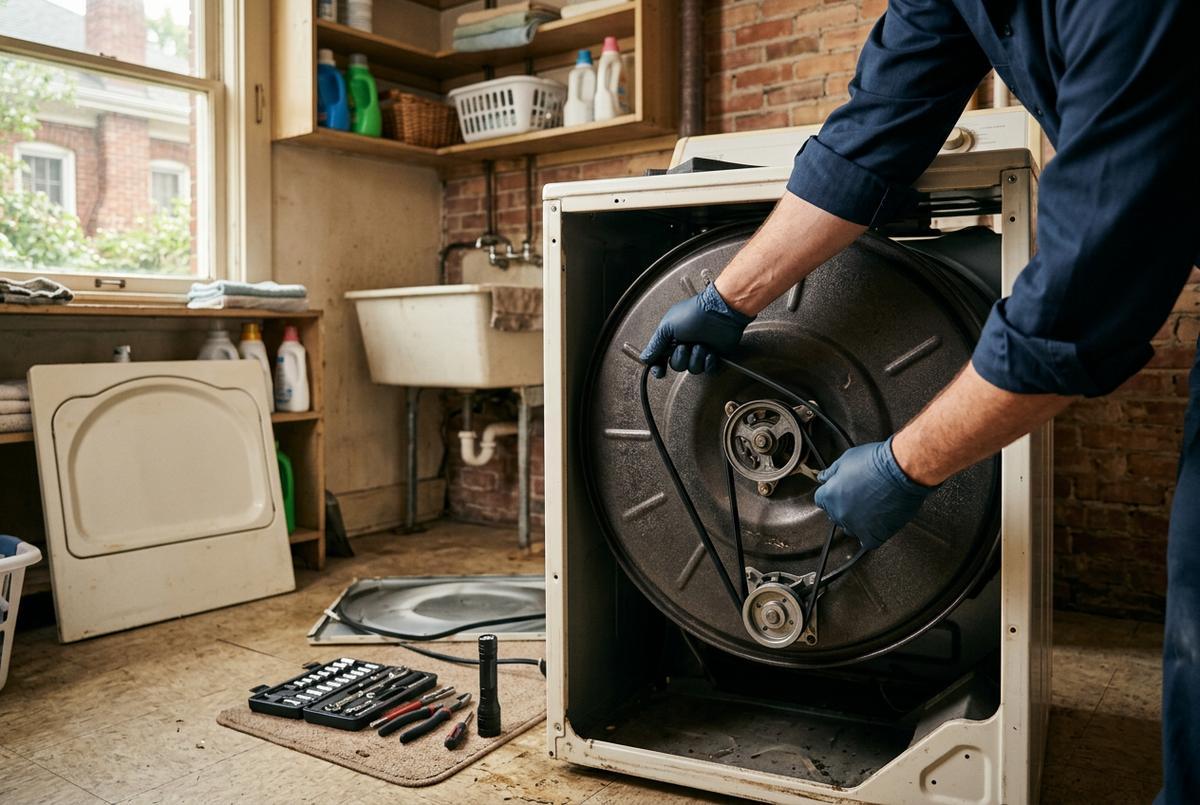
We repair electric and gas dryers, stacked or standalone, on most major brands. A dryer is a heater, a fan, and a turning drum, so when one of those quits the laundry piles up. Heating elements burn open. Thermal fuses blow after lint chokes the vent, belts snap, idler pulleys squeal, door switches stop registering a closed door, and control boards drop cycles halfway through. Gas models add igniters, flame sensors, and gas valve coils to the list. Our technicians run the machine, read the failure instead of guessing at it, and explain what part gave up and why. We check vent restriction too, since it kills more parts than age does. Call us and tell us what you hear and smell.
Call (888) 826-9217- You reach a person, not a menu
- Open every day
- The quote comes first, in writing
Taking calls until 5:00 PM CT
The dryer symptoms we hear most
- "It runs forever and clothes come out damp" Usually a blocked vent, a failed heating element, or a thermostat cutting heat early.
- "Drum spins but there's no heat at all" Points to an open element or a blown thermal fuse. On gas units, a dead igniter or valve coil.
- "Something's screeching every time the drum turns" Worn drum rollers, a dry idler pulley, or a failing blower wheel bearing make that noise.
- "Push start and nothing happens" Door switch, start switch, thermal fuse, or a control board that lost its trigger circuit.
- "There's a hot, scorched smell in the laundry room" Lint packed near the heater, or a restricted exhaust letting temperatures climb past safe limits. Stop using it.
Safe things to check first
Worth a look before you call — sometimes it saves you the visit.
- 1Pull the lint screen and hold it under running water. If water beads on top instead of passing through, that film is blocking airflow.
- 2Go outside and feel the vent hood while the dryer runs; weak or no air means the duct is restricted.
- 3Open and firmly close the door, then press start again, since a loose door catch stops many machines cold.
- 4Check the breaker panel. An electric dryer can tumble on one leg of power while the heat stays dead.
Why homeowners pick a local independent shop
| ACR Service Inc | Big-box repair chains | Handyman listings | |
|---|---|---|---|
| Quote in writing before a wrench comes out | ✓ | ✕ | ✕ |
| Phones answered by people, every day | ✓ | ✕ | ✓ |
| All major brands, gas and electric | ✓ | ✓ | ✕ |
| Independent, no manufacturer quotas | ✓ | ✕ | ✓ |
| Crews familiar with homes like yours | ✓ | ✕ | ✓ |
What homeowners say after the visit
“Washer error code meant nothing to me. He knew it on sight and had it cleared in under an hour.”
June C.Louisville, KY“Polite on the phone, polite at the door, and the laundry room was cleaner when he left than when he came.”
Earl D.New Orleans, LA“Our cooktop had one dead burner for a year. One visit, all five working. Should have called long ago.”
Tess G.Meads, KYDryer Repair — quick answers
Why does my dryer take three cycles to dry one load?
Airflow, almost always. Moist air has to leave the machine, and a crushed duct, long run, or lint-packed vent traps it. A weak heating element or a thermostat opening too soon does the same thing. We test both.
Is it worth repairing or should I replace it?
Depends on the part that failed and the condition of the rest. A belt, roller, fuse, or igniter on a solid machine is worth fixing. A cracked drum or a rusted-through cabinet is a different conversation. We tell you straight.
Do you work on gas dryers as well as electric?
Yes. Gas units share the drum, belt, and blower parts with electric models, then add an igniter, flame sensor, and gas valve coils. Those are common failure points, and our technicians diagnose them on site.
Can you fix a stacked washer-dryer unit?
We do. Stacked and laundry-center units need the pair separated or partly pulled to reach parts, so the visit takes more room and more care. Clear a path to the closet and we'll handle the rest.
My dryer smells burnt. Should I keep using it?
No. Unplug it or shut off the gas and stop running loads. A scorched smell usually means lint has collected near the heat source, or the exhaust is choked. That's a heat problem worth looking at right away.
Do you clean dryer vents during a repair?
We check the vent as part of diagnosis, because restricted airflow burns out fuses and elements. If the duct is the real problem, we'll show you what we found and what needs clearing so the new part lasts.
How it works
- Step 1
Tell us the symptom
Call us or fill out the form. Describe what the appliance does and does not do. Noises, error codes, smells, puddles. Brand and model help. That detail lets us plan the visit right.
- Step 2
We diagnose in person
A technician comes to your kitchen or laundry room and tests the machine instead of guessing. Controls, heating parts, motors, seals, drains. You hear what failed and what the repair involves before work starts.
- Step 3
You approve the repair
Nothing gets replaced until you say go. Common parts are handled on site when we have them. If a part must be ordered, we tell you that up front and schedule the return.
- A real person answers
- Open 7 days
- Written quote before work starts
Why homeowners call us
- Symptoms, not scriptsA washer that fills but never spins is a different problem than one that spins but never drains. We ask questions that narrow it down, then confirm with testing. Guesswork wastes parts and your afternoon.
- Independent and brand-wideWe are not tied to any manufacturer. That means we work on the big laundry and kitchen names side by side, and we recommend the repair that makes sense for your machine, not one brand's playbook.
- Regional coverageBased in Huntsville, we serve homeowners in Alabama, Georgia, Tennessee, Kentucky, Mississippi, Louisiana, Arkansas, North Carolina and South Carolina. One number to call whether you are in a city neighborhood or a small town outside it.
- Straight explanationsYou will hear what part failed and why, in plain words. If a machine is worn past sensible repair, we say so. Homeowners make better decisions when nobody is hiding behind jargon.
- All major brands, gas & electricIndependent service on Whirlpool, LG, Samsung, GE, Maytag, Bosch, KitchenAid and the rest.
- Straight answersSome machines aren't worth the part, and we say so before you spend anything.
Dryer Repair
Small faults become big ones on a schedule of their own
Describe the symptoms and we'll book the visit — takes about a minute.
- A real person answers
- Open 7 days
- Written quotes
- All major brands
- Gas & electric
Rather not call? Get a free quote →